In today’s era of “Smart Agriculture,” producers are overwhelmed by technological solutions. Fields are filled with sensors, weather stations, and telemetry systems. However, one critical question emerges: Does an excess of data truly lead to better decisions?
The Data Paradox
For many producers, the reality is Data Overload. Modern dashboards provide an abundance of information, but often fail to deliver the final decision.
The producer ends up looking at graphs and numbers without knowing exactly what action should be taken in the field.
This situation maintains uncertainty in irrigation, as the responsibility and risk of the final decision remain entirely with the individual, who often falls back on instinct and experience.
Terra MIND: The “Brain” Above the Infrastructure
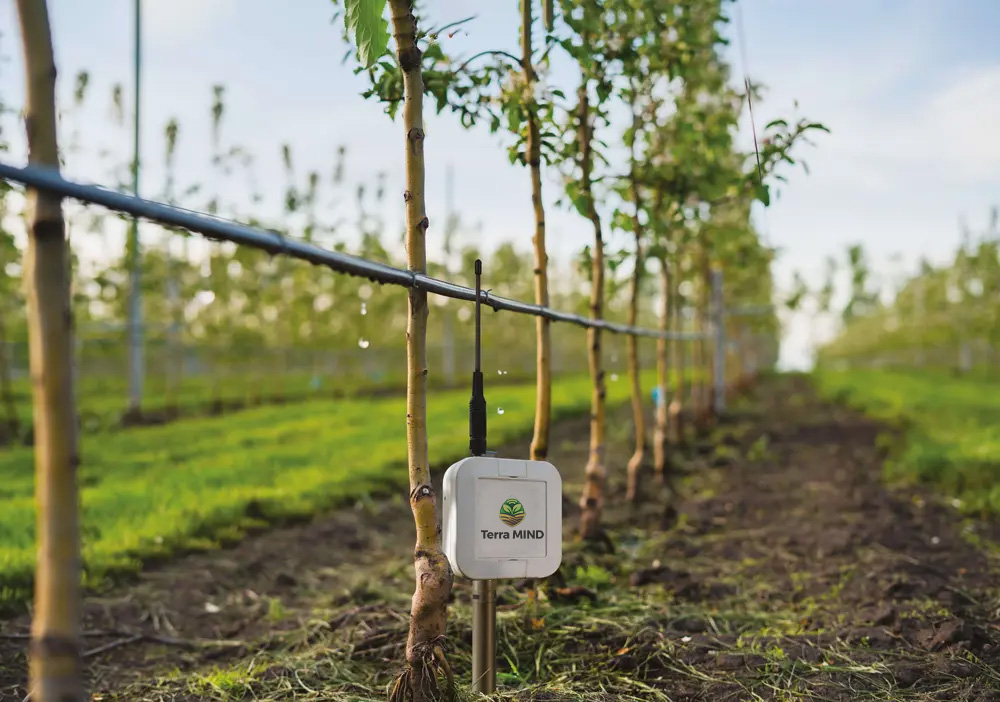
The solution is not adding more sensors, but adding intelligence. Terra MIND is not another data collection system, but an Autonomous Decision-Making Infrastructure.
It functions as the “brain” of smart agriculture, remaining independent of sensor type (sensor-agnostic).
This means it can connect to any existing IoT infrastructure or hardware provider, transforming isolated measurements into agronomic intelligence.
From Measurement to Action: Diagnose – Decide – Act
The key difference of Terra MIND lies in transforming soil, weather, and crop data into actionable decisions through a three-step process:
- Diagnosis (Diagnose): It does not simply analyze isolated measurements, but their combined significance in real time, taking into account phenology and field history.
- Decision (Decide): It evaluates risk and environmental dynamics to determine the optimal course of action, weighing parameters that a simple measurement cannot reveal. It answers precisely “When,” “How Much,” and most importantly “Why” irrigation should take place.
- Action (Act): The decision is transformed into a specific implementation command, enabling autonomous field execution with full documentation.
The Result: Control Instead of Information
The transition from simple information to autonomous control delivers measurable benefits. Replacing empirical estimation with algorithmic management can reduce operational risk by up to 50%.
At the same time, precise dosing based on actual needs achieves significant water optimization and energy savings through reduced pumping station operating hours.
In conclusion, sensors are the “eyes” of the field, but Terra MIND is the “mind” producers need to transform irrigation from an empirical practice into a personalized decision-making infrastructure.